From proprietary chaos to trusted AI infrastructure.
Open protocols for agent federation. Deterministic execution with cryptographic evidence. Governance tokens for corridor control. The foundation of Internet 3.0.
We are in startup mode, and our products will be released after Q2 2026.
Learn More
Building blocks for Internet 3.0
Lane2.ai defines the trust fabric for intelligent systems through six foundational components:
DOP
Deterministic AI execution
A reference model for reproducible workflows and signed outcomes. Ontology-driven orchestration with fail-closed safety. Certified implementations available under licence.
SAPP
Cryptographic evidence engine
Three-level Merkle proof chain at 30,000 RPS. Evidence scoring, liability computation, and QTSP-anchored proof — for any regulated operation, not just AI. Learn more
aARP
Agent discovery and routing
Open discovery, capability adverts, and governed sessions across trust boundaries. Drafted for RFC-class review under FRAND terms.
RTGF
Governance token framework
Corridor permissions, regulatory constraints, and session-scoped authority tokens. Controls what agents are allowed to do, where, and under whose rules.
Ontology Server
Shared domain semantics
Versioned domain knowledge that agents consume at runtime. Payments, healthcare, telco, energy — agents speak the same language because they share the same ontology.
CaaS
Context intelligence signals
A neutral way to share where/when/how safely, without exposing identity or content. Telco and IoT edge intelligence for situational awareness.
Development Timeline & Pilot Readiness
Lane2.ai is an emerging startup developing breakthrough AI agent frameworks for regulated environments. Our production-ready platforms will be delivered in March 2026, with comprehensive tooling for vertical sector deployment.
SAPP — Evidence Infrastructure You Can Buy Today
SAPP operates as a standalone evidence engine for any regulated operation — bank transfers, card payments, AI decisions, SIM swaps, insurance claims. No dependency on the full platform.
Merkle Proof Chain
Three-level proof: evidence root, partition root, global root-of-roots. RFC 6962 compliant. Understood by courts.
EU Qualified Archive
Root-of-roots published to QTSP every 15 minutes. Legal standing under eIDAS 2.0. Independent regulator verification.
Liability Engine
Evidence quality drives liability allocation. Machine-readable commercial agreements enforced at 30,000 RPS. No human judgement at transaction time.
Not Just AI
Bank disputes, card chargebacks, consumer verification, regulator audit. Any operation that needs proof of what happened and who is liable.
Core Technologies
Deterministic Orchestration (DOP)
Pattern-based framework for scaffolding vertical regulatory-safe AI agents using external ontology and rubric tools, enabling rapid deployment in regulated domains.
Evidence Engine (SAPP)
Cryptographically anchored evidence with Merkle proofs, evidence scoring, and automated liability computation. Standalone or integrated with the full platform.
Agent Federation (aARP)
Cross-organizational routing infrastructure enabling AI agents to discover and communicate across organizational boundaries with evidence preservation.
Governance Tokens (RTGF)
Session-scoped authority tokens controlling corridor permissions, regulatory constraints, and cross-boundary agent authorisation. The policy enforcement layer.
Domain Semantics (Ontology Server)
Versioned domain ontologies consumed by agents at runtime. Ensures all agents in a corridor share the same vocabulary, constraints, and regulatory mappings.
Context Intelligence (CaaS)
Telco and IoT edge intelligence providing privacy-preserving situational awareness. Agents consume context signals without building their own sensor stacks.
Technical Architecture
Lane2.ai's platform is built on six foundational components that work together to enable regulatory-safe operations across complex domains — AI agents, bank transfers, card payments, and any regulated workload:
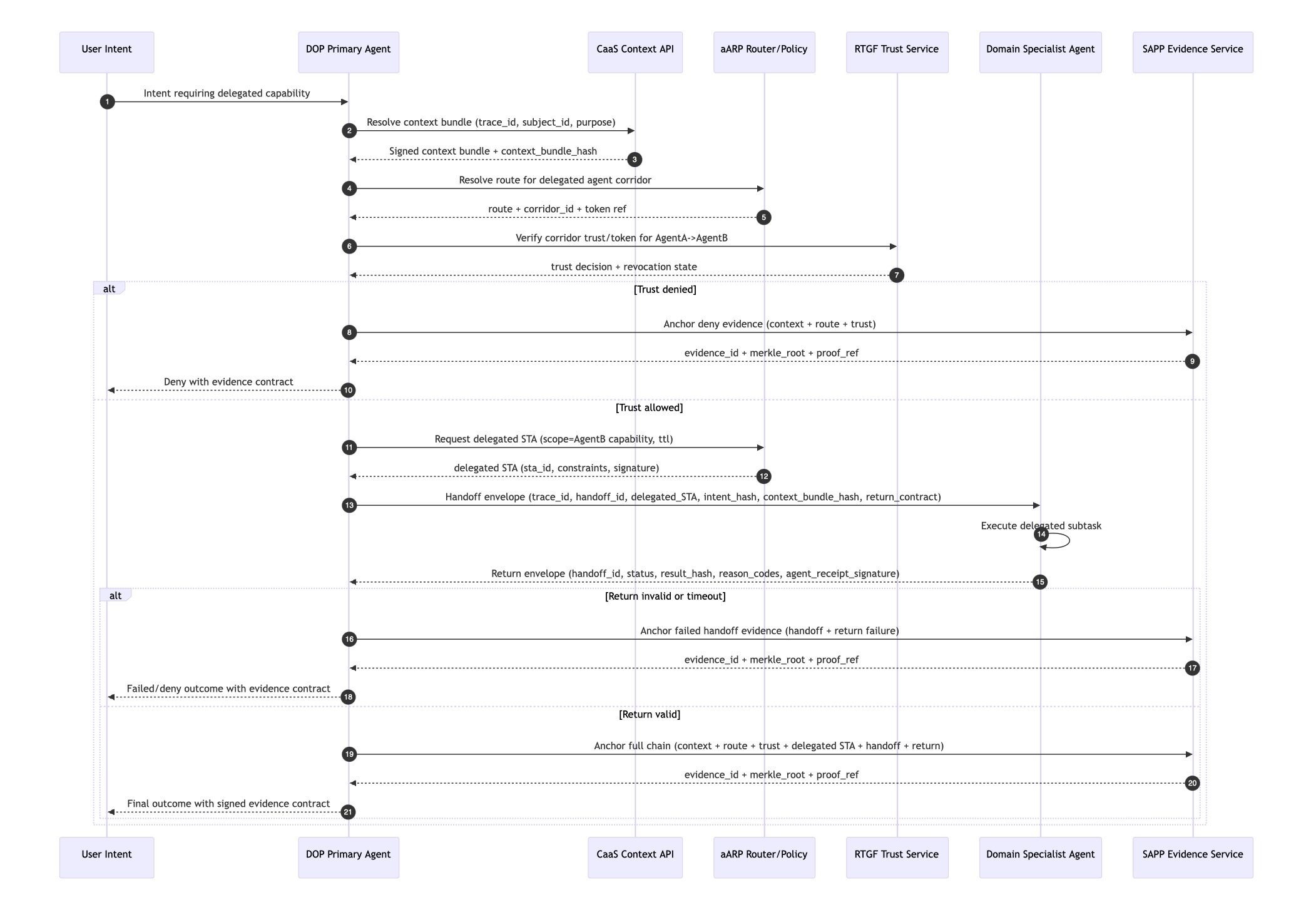
End-to-End Protocol Flow: 21-step sequence from user intent through context (CaaS), routing (aARP), trust (RTGF), delegation, execution, and evidence anchoring (SAPP) — including deny and failure paths
Deterministic Orchestration (DOP)
DOP is NOT a single orchestration engine — it's a framework allowing thousands of specialised, conformant agents to be built, deployed, and discovered on a federated network, each with:
- Domain-specific ontologies consumed from the Ontology Server at runtime
- Specialised rubrics for decision-making within their domain expertise
- Domain tools and integrations for their specific area of responsibility
- Vector memory storing domain-specific patterns and learning
- Fail-closed compliance ensuring safe operation within domain constraints
Evidence Engine (SAPP)
SAPP produces cryptographically anchored evidence for every regulated operation:
- Three-level Merkle proof chain — evidence root, partition root, global root-of-roots (Ed25519 signed)
- Evidence scoring — 10+ categories with weighted confidence (0.0–1.0), YAML-configurable
- Liability computation — evidence quality drives deterministic allocation from pre-agreed commercial terms
- QTSP anchor — root-of-roots published to EU Qualified Archive every 15 minutes for legal standing
- 30,000 RPS sustained throughput, 12ms P50 latency, schema-free JSONB storage
Agent Federation (aARP)
aARP enables agent service discovery and secure communication across organisational federations or local internal deployments:
- Capability adverts — agents publish what they can do; aARP resolves the right counterpart
- Governed sessions — consent-driven data sharing under policy and trust anchors
- Trust verification between agents from different trust domains
- Evidence preservation — every cross-boundary interaction produces SAPP-anchored proof
Governance Tokens (RTGF)
RTGF controls what agents are allowed to do across corridors:
- Session-scoped authority tokens — agents carry proof of what they're permitted to do
- Corridor permissions — bilateral or multilateral agreements encoded as token policies
- Regulatory constraints — regulator-mandated rules enforced at the token level
- Token lifecycle — issuance, verification, revocation, and audit trail
Ontology Server
The shared domain knowledge layer that makes agents interoperable:
- Versioned domain ontologies — payments, healthcare, telco, energy, logistics
- Runtime consumption — agents pull ontology at startup, not compile-time binding
- Regulatory mappings — ontology nodes carry compliance obligations per jurisdiction
- Semantic consistency — all agents in a corridor share vocabulary, constraints, and meaning
Context Intelligence (CaaS)
CaaS provides the sensory foundation that feeds intelligence to all domain agents:
- Telco network intelligence as the base layer for behavioural and location context
- IoT device aggregation from millions of city sensors and devices
- Edge processing that derives actionable intelligence before sending to agents
- Real-time context streams that domain agents consume for decision-making
How the Layers Work Together
From signal to signed, anchored outcome — in six steps.
Sense (CaaS)
Network and IoT context is collected at the edge and distilled into privacy-preserving "context claims" (e.g., location class, service availability, environment state).
Understand (Ontology Server)
Agents consume versioned domain ontologies at runtime — shared vocabulary, regulatory mappings, and domain constraints. All agents in the corridor speak the same language.
Discover & Route (aARP)
Agents publish capabilities; aARP resolves the right counterpart under policy and consent, then establishes a governed session across trust boundaries.
Authorise (RTGF)
Governance tokens grant session-scoped permissions — corridor access, regulatory constraints, and bilateral agreements. The agent carries proof of what it is allowed to do.
Execute (DOP)
The receiving domain runs a deterministic workflow: ontology-bound policy is applied, inputs are validated against RTGF permissions, and the action is executed in a reproducible way.
Prove & Anchor (SAPP)
Every step produces signed evidence anchored in a Merkle proof chain. Evidence is scored, liability is computed, and the proof is published to an EU Qualified Archive — admissible in court, verifiable by regulators.
Outcome
Cross-domain AI that is predictable, auditable, and privacy-respecting — with cryptographic proof anchored to EU legal infrastructure.
Agents and CaaS: Context as an Active Intelligence Source
While CaaS continuously senses and publishes environment state, it also exposes a context intelligence interface that authorized agents can directly query or subscribe to. This gives agents a shared, trustworthy situational awareness layer without requiring each one to build its own sensor or data integration stack.
Two Interaction Modes
Passive Signal Subscription
Agents receive signed "context claims" as event streams:
These signals can automatically trigger routing or orchestration workflows through aARP and DOP.
Active Context Query
Agents can request higher-level context summaries or validations:
CaaS responds with verified, privacy-preserving context data derived from network and IoT sources.
Vector Memory and Context Correlation
Agents retain vectorized memory of prior contexts and results, allowing them to compare current CaaS signals with historical patterns. This supports adaptive behavior — for instance, improving routing choices or identifying anomalies — without breaking the deterministic guarantees enforced by DOP.
Pattern Learning
Agents improve decision-making through historical pattern recognition
Anomaly Detection
Deviation from established patterns triggers enhanced scrutiny
Regulatory Compliance
DOP maintains deterministic, auditable execution despite adaptive learning
Core Design Principles
Semantic Consistency
Every federated AI service speaks the same ontological language through standardized templates, ensuring seamless interoperability across systems.
Evidence Mathematics
All AI interactions generate standardized evidence bundles with mathematical confidence scoring, providing quantifiable trust and auditability.
Regulatory Compliance
Templates enforce safety constraints, PII protection, and audit trail requirements at the architectural level, ensuring built-in compliance.
Federated Routing
Services advertise capabilities through aARP-compatible metadata, enabling intelligent routing across organizational boundaries.
Regulatory-First Architecture
Our DOP architecture provides comprehensive compliance coverage across 45+ regulatory frameworks spanning EU, US, UK, and APAC jurisdictions.
Governance & Privacy
Lane2's architecture enforces consent, purpose limitation, and minimal disclosure by design. Context is signed at the edge, routing is governed by policy and trust anchors, and execution produces tamper-evident records. No raw personal data is required for agents to cooperate, and every cross-domain interaction can be explained without exposing sensitive content.